
 Posted by
 During a recent interview for her online course, Adi Mazor Kario asked me about my favorite innovation tools and methods. While I am mostly framework agnostic, the assumption-mapper is one of the tools I use most consistently.
When projects or ideas fail, it is either because of poor execution or because some underlying assumptions were wrong. At the same time, in traditional project management, these assumptions are unlikely to be evaluated and continuously prioritized once a project has kicked off
The assumption-mapper is a simple tool that helps think through and prioritize which assumptions to test early and aggressively. It’s made up of 3 easy steps:
- Collect your assumptions
- Assign confidence and impact levels
- Identify critical assumptions
Collecting assumptions
Let’s say you are building Silver Date, a dating app for retired people, and are putting together a prototype to see whether your idea makes sense. What are the questions you should try to answer with your prototype?
Assumptions for a new product or service generally fall into one of three categories:
- Desirability: Do people want this?
- Feasibility: Can we build it?
- Viability: Can we make a profit with it?
I recommend focusing on desirability early on. It is generally easier to find workarounds for technical challenges or pricing issues than it is to make a customer buy a product that doesn’t solve a problem for them.
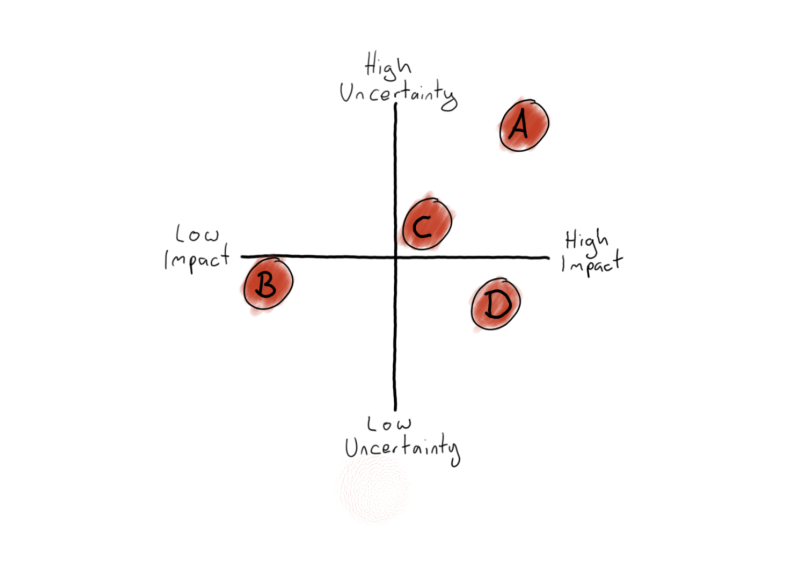
For Silver Date, four desirability assumptions come to mind:
A: Retirees are open to online dating
B: Retirees are willing to pay for a dating service
C: Many retirees own smart-phones
D: Retirees want to date
Scoring uncertainty and impact
Once you have put together a list, it’s time to score each assumption on two dimensions. Uncertainty describes how sure you are about a given assumption. Impact describes how much it will hurt your project if you are wrong about it. I used to go with “high/medium/low” for these scores, but more often than not, you’ll end up with a few clusters of assumptions with the same ranking. Instead, I now use “high/above average/below average/low,” which tends to spread them out a bit more.
For Silver Date it could look something like this:
A: Retirees are open to online dating
- high uncertainty (if, for example, there is not a lot of data available)
- high impact (if they’re not open to it, they won’t use an app)
B: Retirees are willing to pay for a dating service
- below average uncertainty (you found data on traditional match-making services that suggests that seniors are willing to pay)
- below average impact (even if you can’t charge your users, you can find other ways, such as ads, to monetize your product)
C: Many retirees own smart-phones
- above-average uncertainty (you only have anecdotal information at this point)
- above-average impact (if you are wrong about this assumption, you probably need to rebuild Silver Date as a web-app)
D: Retirees want to date
- below average uncertainty (you know plenty of seniors who date)
- above average impact (if they don’t date in the first place, they probably won’t start doing it online)
Identifying critical assumptions
Based on the uncertainty and impact scores, you can identify your critical assumptions. Anything that scores high in both categories should be on your priority list. Depending on how many assumptions this yields, you may want to include assumptions that have a combination of high and above average.
For Silver Date, “Retirees are open to online dating” clearly is the most critical assumption and one that you should be able to answer through your prototype.
“Many retirees own smart-phones” is also essential. Ideally, you would know about this before you even start developing your prototype. Luckily, you should easily be able to find out more with a bit of desk research.
Visualizing the result
You may decide to plot the result onto a 2×2 matrix or even do the whole exercise by moving post-its around a whiteboard.
Visualization can be helpful, but the value of the assumption mapper lies in thinking through uncertainty and impact.
Now what?
Based on the result, you can now draw up experiments to test your critical assumptions quickly and cheaply. I recommend not cramming more than 2 or 3 critical assumptions into one experiment because you add complexity and lose speed.
For Silver Date, you might decide that you don’t need a full-blown prototype. Instead, you might want to go with a “painted door”: create a simple landing page and buy a few Facebook ads. This will be enough to see whether you can get your target audience to sign up for your (non-existent) service.
The assumption mapper is not a one-and-done step. After you’ve run your experiment, you’ll have proven or disproven some things. You’ll very likely have uncovered some hidden assumptions or come up with new ones based on the results.
Now is a great time to capture those findings and re-score your list of assumptions to make sure you will focus on the right questions with your next step.
And that’s it. You now have an easy to use tool to make sure you are testing the right things with your experiments. No magic or rocket science involved.
 Nico Eggert